




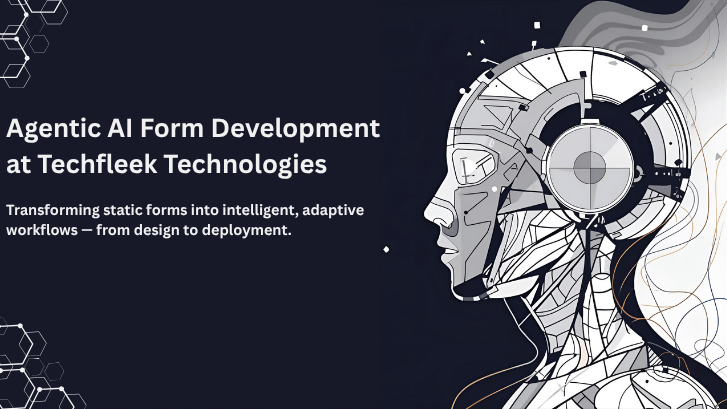
Transforming static forms into intelligent, adaptive workflows — from design to deployment.
Techfleek Technologies is pioneering Agentic AI–powered forms that think, plan, and act. Our systems autonomously prefill and validate data, personalize user journeys, and escalate complex cases to humans — improving completion rates, accuracy, and overall user experience.
This guide outlines our end-to-end framework: from UX design and AI orchestration to secure production deployment.
What is Agentic AI?
Agentic AI represents a shift from passive AI to goal-driven, autonomous systems.
Rather than just responding to prompts, these agents plan, decide, and execute tasks using APIs and tools to deliver real business outcomes.
Aligned with frameworks from IBM, NVIDIA, and leading cloud providers, Agentic AI integrates iterative reasoning, memory, tool use, and safe human oversight — bridging AI intelligence with enterprise-grade control.
Why Forms Need Agents
Forms are often dynamic, multi-step, and context-sensitive — ideal for agent-driven automation.
Agentic AI enables forms that:
- Ask only relevant questions based on prior answers.
- Validate or prefill data through real-time service calls (KYC, CRM, payments).
- Adapt flows to user confidence and business logic.
According to Typeform, conversational forms improve completion rates by up to 47%, making adaptive UX critical for business success.
At Techfleek, we tailor layouts — conversational or structured — based on domain sensitivity, regulation, and precision needs.
Reference Architecture
Our modular Agentic Form Architecture blends flexibility, security, and explainability:
- Orchestrator: LangGraph manages states, logic branches, retries, and human-in-loop approvals.
- Policy Model: LLM with function calling ensures deterministic, schema-bound outputs.
- Tools: Typed APIs for validation, KYC, CRM/ERP, payments, RAG, and notifications.
- Memory: Contextual short-term and long-term memory for personalization.
- Adaptive UI: Responsive form components with conditional logic and progressive disclosure.
- Observability: Complete traceability, audits, and replay features for compliance and debugging.
Design Principles
- One question at a time: Reduce cognitive load and improve completion.
- Transparency: Clearly explain why data is collected and when humans may step in.
- Accessibility-first: Ensure keyboard navigation, mobile optimization, and real-time validation.
- Purpose-driven design: Choose conversational or structured layouts by use case, not trend.
Development Workflow
- Define goals & guardrails: Set KPIs (completion rate, latency) and escalation rules.
- Map data flow: Identify dependencies, validations, and external integrations.
- Implement typed tools: Wrap all APIs (KYC, CRM, payments) with strict schemas.
- Build the agent: Start with a single planner, then add validators/reviewers for reliability.
- Design adaptive UI: Implement conversational or responsive logic with inline validation.
- Add observability: Capture traces, metrics, and replay capabilities for debugging.
- Pilot & iterate: Analyze drop-offs and refine flows based on user insights.
Recommended Tooling
- LangGraph: Stateful orchestration with retries, branching, and checkpoints.
- AutoGen / AG2: Multi-agent collaboration for complex workflows.
- Adaptive UI Frameworks: Reference Adobe AEM Adaptive Forms for logic-rich interfaces.
- Learning Resources: LangGraph tutorials, agentic workflow templates, and open-source sandboxes.
Safety, Privacy & Compliance
Techfleek adheres to global AI governance frameworks:
- NIST AI RMF (Govern, Map, Measure, Manage) for structured risk control.
- ISO/IEC 42001 for operational AI governance and continual improvement.
- OpenAI Model Spec principles for permissible actions, refusal behavior, and escalation.
We prioritize data minimization, explicit consent, and full auditability, ensuring every action and API call is logged and monitored.
Evaluation Metrics
- Experience: Completion rate, time-to-complete, user satisfaction (NPS).
- Quality: Tool-call success, validation accuracy, error/override rates.
- Reliability: Latency adherence, fallback handling, and review turnaround.
Common Pitfalls to Avoid
- Excessive autonomy without guardrails.
- Unclear data policies or lack of transparency.
- Weak validation against prompt injection or unsafe tool use.
Starter Use Cases
- Customer Onboarding & KYC: Real-time validation with adaptive questioning.
- Credit & Benefit Applications: Auto-prefill and reason-based form reduction.
- IT & Support Automation: AI-driven triage with human fallback for edge cases.
At Techfleek Technologies
We’re redefining how enterprises interact with forms — turning every submission into an intelligent, guided conversation.
From design to deployment, our Agentic AI solutions enable businesses to launch adaptive, compliant, and human-aware digital experiences at scale.